
In 1967, De Nederlandsche Leeuw, a Dutch genealogical publication, released a detailed genealogy of the de Veer family, which was authored M. R. H. Calmeyer, J. H. de Veer and J. F. van West de Veer.
Forty years before that, Calmeyer, then a Dutch military officer, had self-published his own research on the de Veer family line, from which he was descendent through his mother.
Barry Teichroeb obtained a copy of that document, and has published a translated version of it, along with his own analysis on his website: mooserungenealogy.com.
Additionally, Dutch anthropologist Arlette Kouwenhoven researched the de Veer/Fehr family line extensively for her remarkable book, The Fehrs: Four Centuries of Mennonite Migration.
From these sources, we know the following:
- Debora Harnasveger married Gijsbert de Veer in 1580.
- Gijsbert had moved to Amsterdam from Schiedam two years prior, when he was 22. (His ancestry traced to the port town of Veere, where Jan Gijsbrecht de Veer was born in 1521. Gijsbert himself was born in Schiedam on May 14, 1556).
- Debora and Gijsbert were part of the “De Zes Kruikjes” congregation (or “The Six Little Jugs”), which was located in a warehouse and took its name from the tavern next door, as was common in those days.
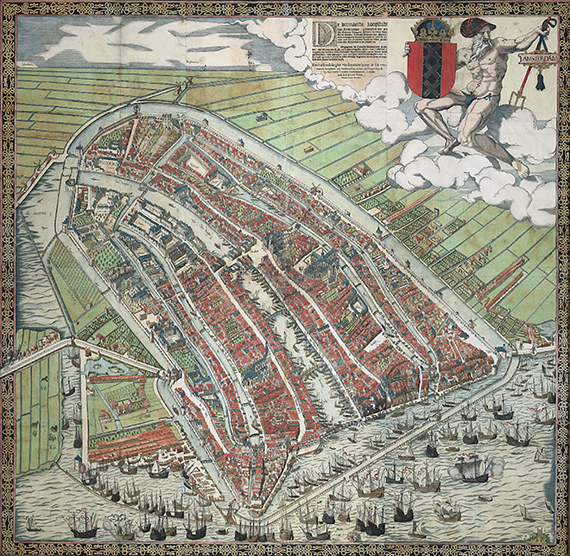
- Debora and Gijsbert rented a house in Lastage, an area just outside the eastern city walls (depicted in the bottom left of the 1544 map of Amsterdam by Cornelis Anthonisz, from the collection of the Rijksmuseum Amsterdam, shown below).
- In 1601, Debora (then 41) and Gijsbert (then 45) purchased a house in Amsterdam, not far from where they had rented. Gijsbert also successfully registered as a citizen of Amsterdam, which was still quite rare for Mennonites. By this time, they had accumulated quite a bit of wealth through their grain trading business, which had them travel between Amsterdam and Danzig.
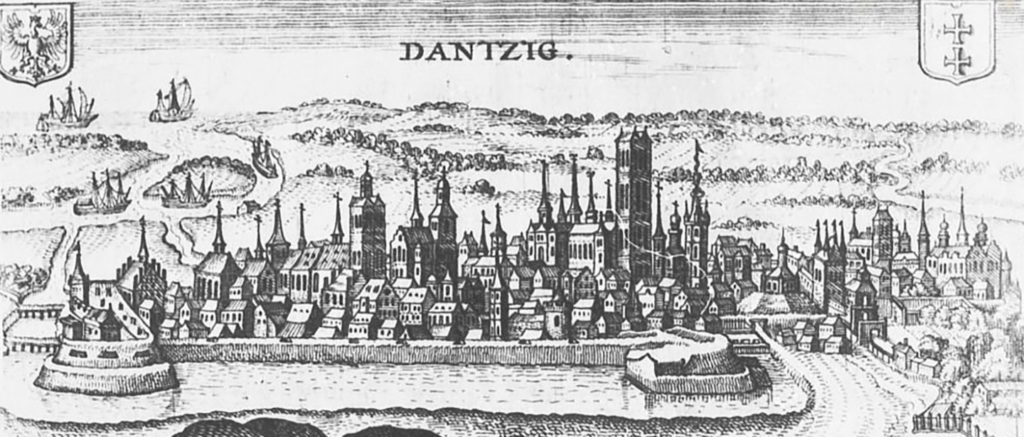
- In 1612, they settled in Danzig permanently, with their children Abraham, Anneke, Hans, Jacob, twins Cornelius and Gijsbert II, and Harman. (Danzig is depicted in the sketch below, dated 1628).
- Their eldest, Nicolaes, stayed in Amsterdam. In 1619, he purchased the elaborate Rustenburgh estate along the Amstel River, near where Rustenburgerstraat is now located.
- In 1632, Nicolaes was elected as a preacher of the Old Flemish congregation in Amsterdam.
- Some of his descendants remained involved in trading and eventually moved to Dutch territories in the Caribbean and the Dutch East Indies (now Indonesia).