
Dutch anthropologist Arlette Kouwenhoven researched the de Veer/Fehr family line extensively for her remarkable book, The Fehrs: Four Centuries of Mennonite Migration.
Kouwenhoven drew on original archival sources to reveal:
Benjamin de Veer was the grandson of Gijsbert III and Catharina von Roy, and the only child of Cornelius de Veer. His mother’s name is unknown. Both of his parents died while he was still young—likely during the devastating plague of 1708.
The impact of the plague was immense. In its first year alone, roughly 23,000 of Danzig’s 70,000 residents died. Among Mennonites in the region, an estimated 40% of the population perished.
A contemporary account described the disease in stark terms: it “rots the blood very suddenly,” producing boils in the throat, armpits, breasts, and groin, along with carbuncles and dark purple spots—ending, almost inevitably, in death.
In 1716, just two years after the plague had fully subsided, Benjamin—then about 20 years old—married Barbke Momber, who was 53 (as recorded in the church register below—see the dark red arrow)
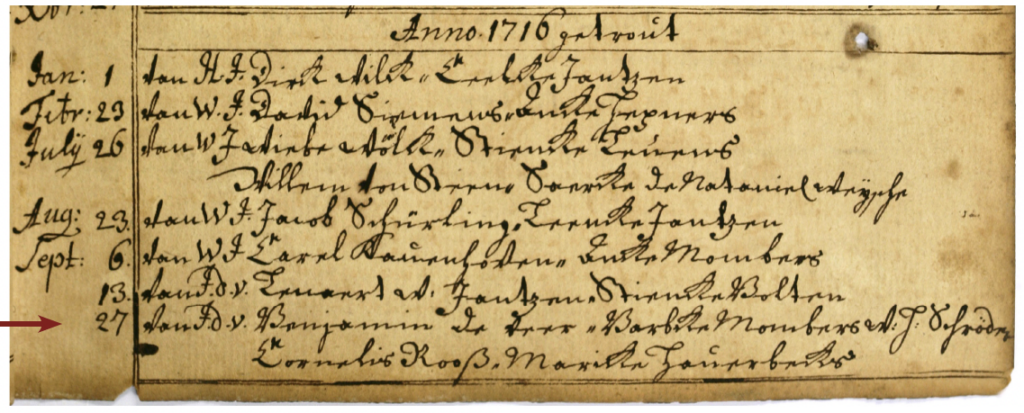
- Barbke died in 1726, ten years after they married.
Four years later, on November 12, 1730, Benjamin, then 34 years old, married 20-year-old Liescke Wiens (as recorded in the church register, shown below—see the dark red arrow).
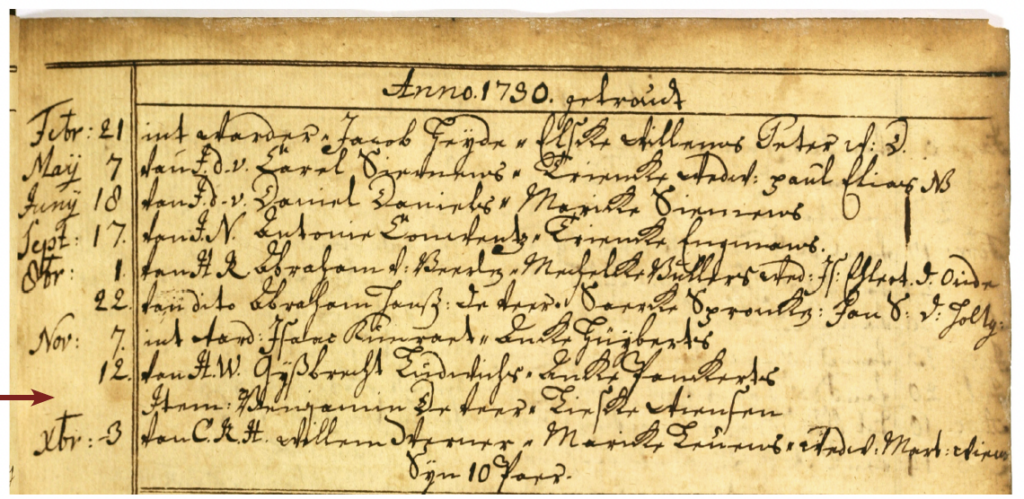
- In 1733, Benjamin and Liescke had their first child, a son named Benjamin. That same year, the death of Polish King Augustus II led to war with the Russians. In 1734, forty thousand Russian troops besieged Danzig, discharging 4,430 bombs, destroying 1,800 houses and killing at least 1,500 residents.
In 1735, Benjamin and Liescke had a baby girl named Liescke.
Benjamin’s wife died on September 17, 1741 at the age of 32.
Benjamin died on May 15, 1743 in the suburbs of Danzig at the age of 47.
The younger Benjamin and Liescke were orphans at the age of 10 and 8 respectively.