
In Lineage, Jakob Claesz. Harnasveger is an armourer drawn into dangerous currents not by grand ambition, but by deep personal conviction in a time when believing differently than the authorities required was a crime.
What follows here steps out of the realm of historical fiction and into archival records. Court examinations, sentences, and correspondence from Amsterdam and The Hague allow us to trace Jakob’s real life with unusual clarity—what he was accused of, whom he was connected to, how authorities understood his actions, and how narrowly he escaped a far harsher fate.
These documents do not tell us everything, but they tell us enough to see the human being behind the name, standing where ordinary life and extraordinary faith collided in the 1500s.
I am grateful to Dr. Jaap Geraerts (academia.edu; livesandletters.ac.uk), Dutch genealogist Odette Franssen (geneanet.org), and historian Barry Teichroeb (mooserungenealogy.com) for sharing background research and their personal correspondence.
[Amsterdam Municipal Archive (Stadsarchief Amsterdam), Judicial Archive, inv. no. 271, fol. 425; published in A.F. Mellink Amsterdam en de wederdopers in de zestiende eeuw, p. 37]
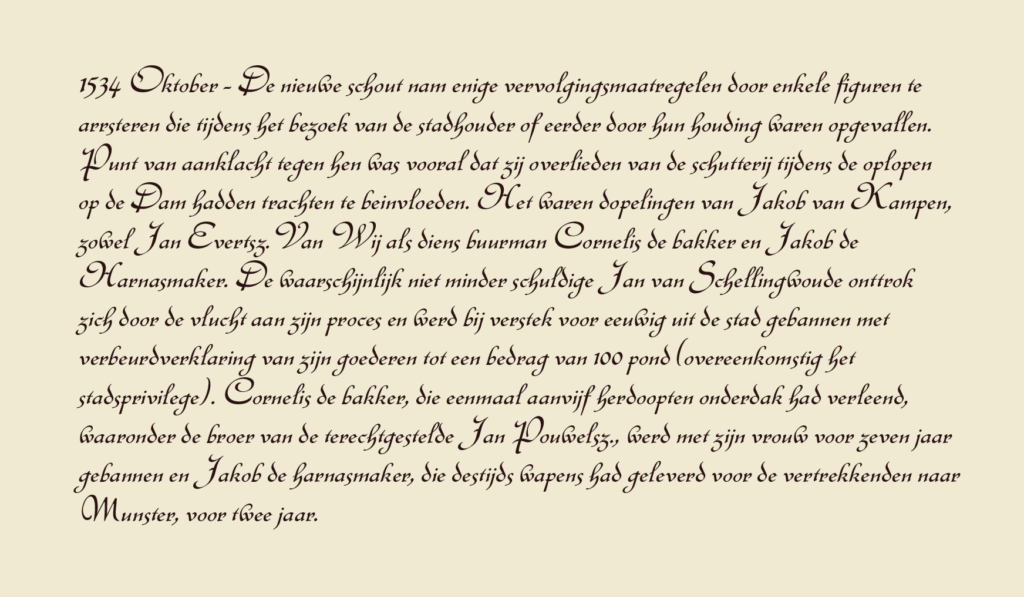
1534 October – The new sheriff took several prosecutorial measures by arresting a number of individuals who had drawn attention through their conduct during the visit of the stadholder earlier. The main charge against them was that they had attempted to influence officers of the civic militia during the gatherings on the Dam. They were baptizers associated with Jakob van Kampen: Jan Evertsz. van Wij, his neighbour Cornelis the baker, and Jakob the armourer.
“Jan van Schellingwoude, who was probably no less culpable, evaded his trial by fleeing and was sentenced in absentia to perpetual banishment from the city, with confiscation of his property up to the value of 100 pounds (in accordance with the city privilege). Cornelis the baker, who had once given shelter to five rebaptized persons, including the brother of the executed Jan Pouwelsz., was banished together with his wife for seven years, and Jakob the armourer, who at the time had supplied weapons to those departing for Münster, for two years.”
[Amsterdam Municipal Archive (Stadsarchief Amsterdam), Judicial Archive, inv. no. 567, fol. 47v; published in A.F. Mellink (ed.), Documenta Anabaptistica Neerlandica, p. 81]
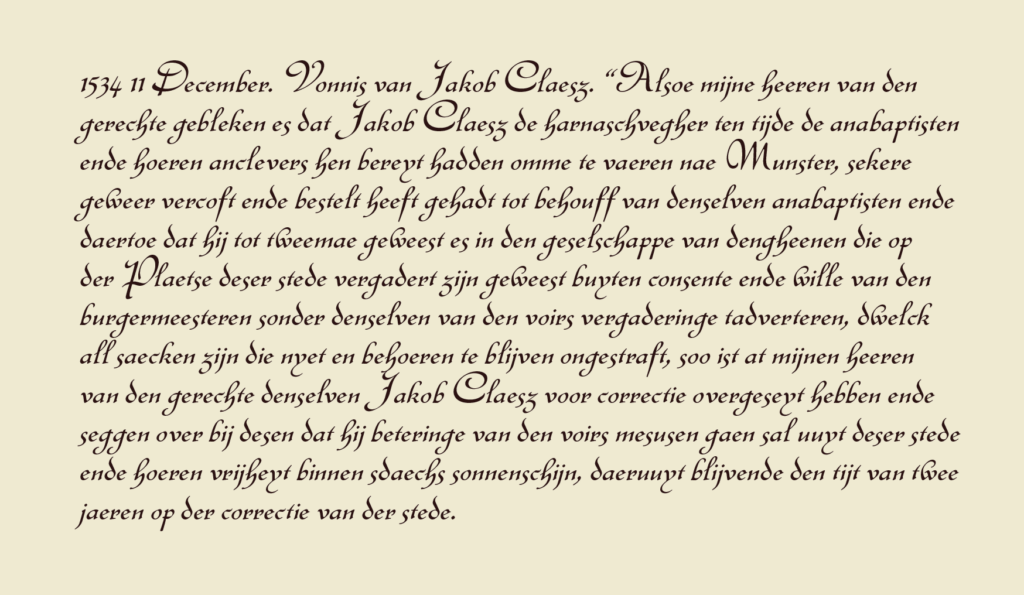
1534 11 December. Verdict against Jakob Cleasz. Whereas it has been shown to my lords of the court that Jakob Claesz., the armourer, at the time when the Anabaptists and their adherents were preparing to travel to Münster, sold and arranged certain weapons for the benefit of those same Anabaptists; and further that he was twice in the company of those who had assembled at the Plaetse of this city without the consent or will of the burgomasters, and without informing them of the aforesaid gathering — all of which are matters that ought not to remain unpunished — therefore it is that my lords of the court have decreed, and hereby decree, that the said Jakob Claesz., by way of correction, shall amend the aforesaid misconduct by departing from this city and its liberties within one day’s sunshine, remaining absent for the period of two years, under correction of the city.
[Amsterdam Municipal Archive (Stadsarchief Amsterdam), Judicial Archive, inv. no. 567; A.F. Mellink (ed.), Documenta Anabaptistica Neerlandica, p. 84 and 85]
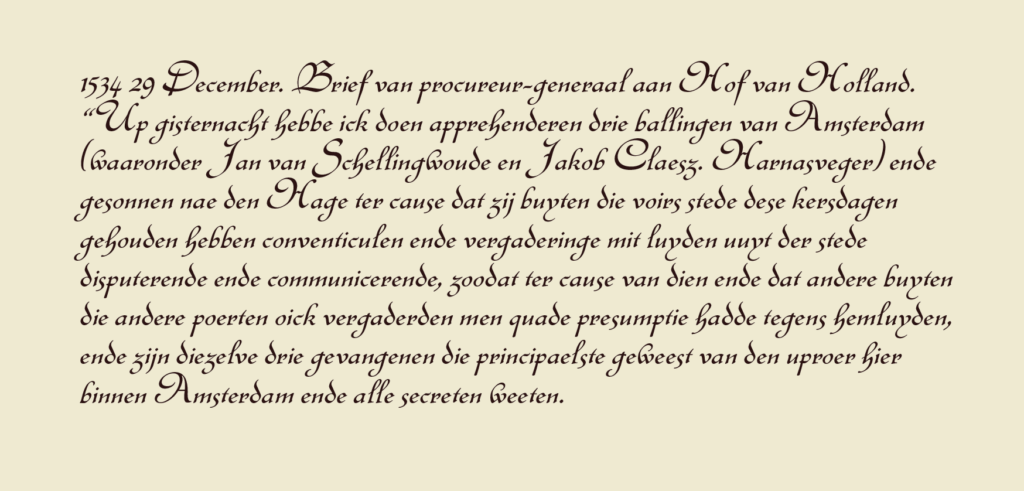
1534 29 December. Letter from the Procurator General to the Court of Holland – Last night I caused three exiles from Amsterdam to be apprehended (among them Jan van Schellingwoude and Jakob Claesz. Harnasveger) and sent to The Hague, because outside the aforesaid city during these Christmas days they had been holding conventicles and gatherings with people from the city, disputing and communicating together. For this reason, and because others were also assembling outside the other gates, there was strong suspicion against them. These same three prisoners had been among the principal instigators of the uprising here in Amsterdam and know all the secrets.
[National Archives of the Netherlands (The Hague), Archive of Central Government Officials, inv. no. 93; A.F. Mellink (ed.), Documenta Anabaptistica Neerlandica, p. 97]
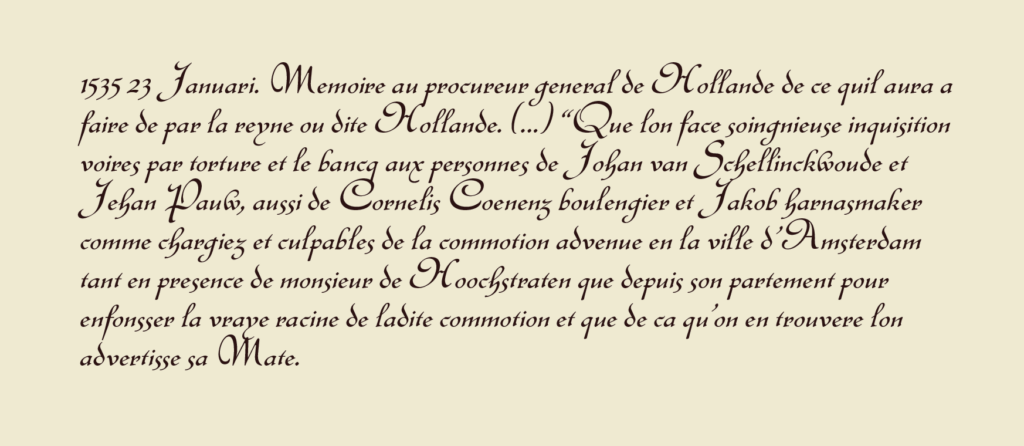
1535 23 January. Memorandum to the Attorney General of Holland concerning what he is to do on behalf of the Queen – “…That careful inquisition be made—even by torture and the rack—of the persons of Johan van Schellinckwoude and Jehan Pauw, as well as Cornelis Coenenz, baker, and Jakob the armourer, as being charged and culpable in the disturbance that occurred in the city of Amsterdam, both in the presence of Monsieur de Hoogstraten and after his departure, in order to uncover the true root of the said disturbance; and that whatever shall be discovered thereof be reported to Her Majesty.”
[Amsterdam Municipal Archive (Stadsarchief Amsterdam), Judicial Archive, inv. no. 269, fols. 35v–37; published in A.F. Mellink (ed.), Documenta Anabaptistica Neerlandica, p. 153]
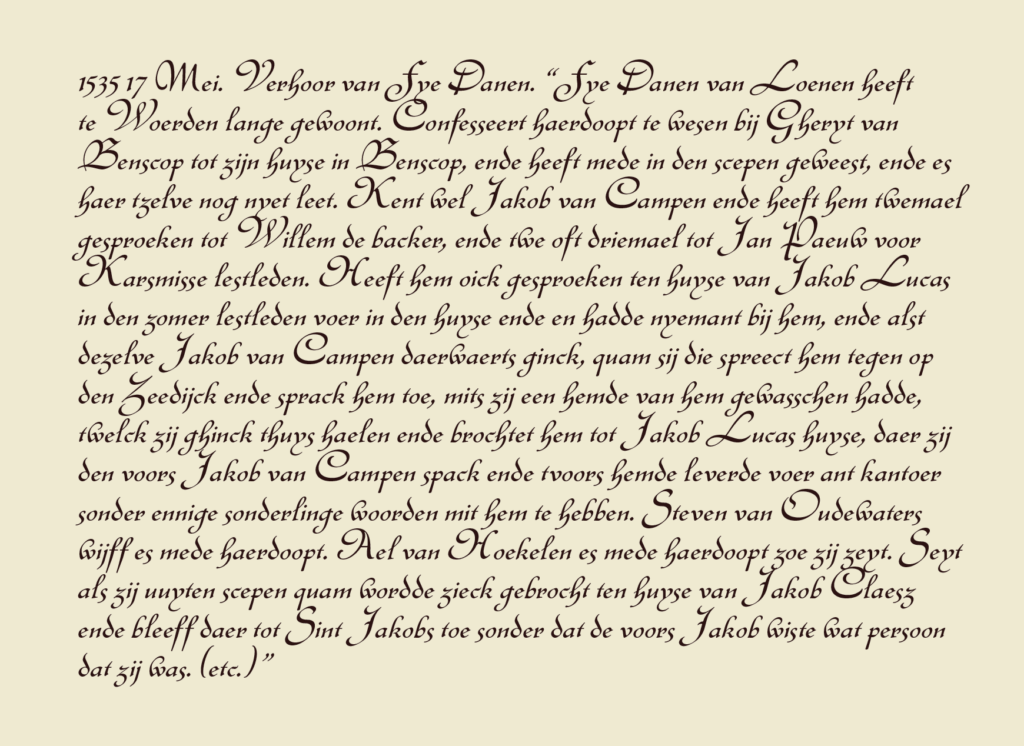
1535 17 May. Examination of Fye Danen. “Fye Danen of Loenen has lived a long time in Woerden. She confesses to having been rebaptized by Gheryt of Benschop at his house in Benschop, and that she has also been ‘in the ship,’ and she does not yet regret this.
She knows Jakob van Campen well and has spoken with him twice at Willem the baker’s, and two or three times at Jan Paeuw’s before last Christmas.
She also spoke with him at the house of Jakob Lucas in the summer last past, in the front room of the house, and there was no one with him. And when the said Jakob van Campen was going that way, she came to meet him on the Zeedijk and spoke to him, because she had washed a shirt of his, which she went home to fetch and brought to Jakob Lucas’s house, where she spoke with the aforesaid Jakob van Campen and delivered the said shirt in the front room, without having any particular conversation with him.
The wife of Steven of Oudewater has also been rebaptized.
Ael of Hoekelen has also been rebaptized, so she says.
She says that when she came out of the ship she was taken ill and was brought to the house of Jakob Claesz., and remained there until St. James’s Day, without the aforesaid Jakob knowing what sort of person she was. (etc.)”

[A.F. Mellink Amsterdam en de wederdopers in de zestiende eeuw, p. 69]
1535 – On 5 July, President Van Assendelft and Brunt again travelled to the city on the IJ, where Jakob van Kampen was confronted with his baptizee Jakob Claesz., the armourer, who was imprisoned in The Hague.
[A.F. Mellink Amsterdam en de wederdopers in de zestiende eeuw, p. 76-77]
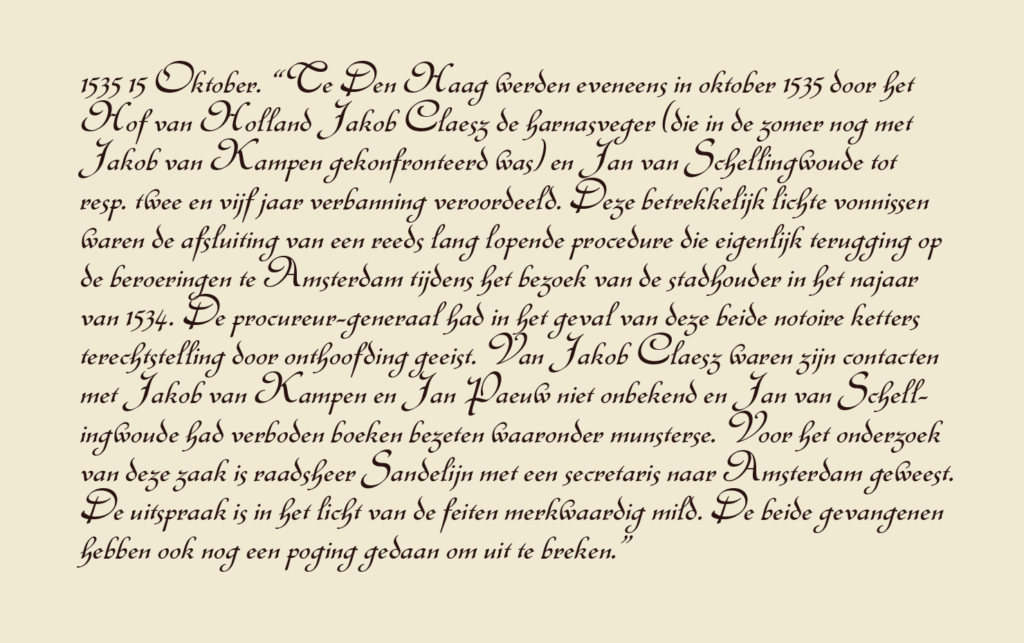
1535 15 October. In The Hague, likewise in October 1535, the Court of Holland sentenced Jakob Claesz., the armourer (who during the summer had already been confronted with Jakob van Kampen), and Jan van Schellingwoude to banishment for two and five years respectively. These relatively light sentences marked the conclusion of a procedure that had already been underway for a long time and in fact went back to the disturbances in Amsterdam during the visit of the stadholder in the autumn of 1534. In the case of these two notorious heretics, the procurator general had demanded execution by beheading.
Jakob Claesz.’s contacts with Jakob van Kampen and Jan Paeuw were well known, and Jan van Schellingwoude had possessed forbidden books, including Münsterite ones. For the investigation of this case, Councillor Sandelijn, accompanied by a secretary, travelled to Amsterdam. In light of the facts, the verdict is strikingly mild. The two prisoners also made an attempt to escape.
[Amsterdam Municipal Archive (Stadsarchief Amsterdam), Judicial Archive, inv. no. 271, fol. 425; published in A.F. Mellink (ed.), Documenta Anabaptistica Neerlandica, pp. 7-8]
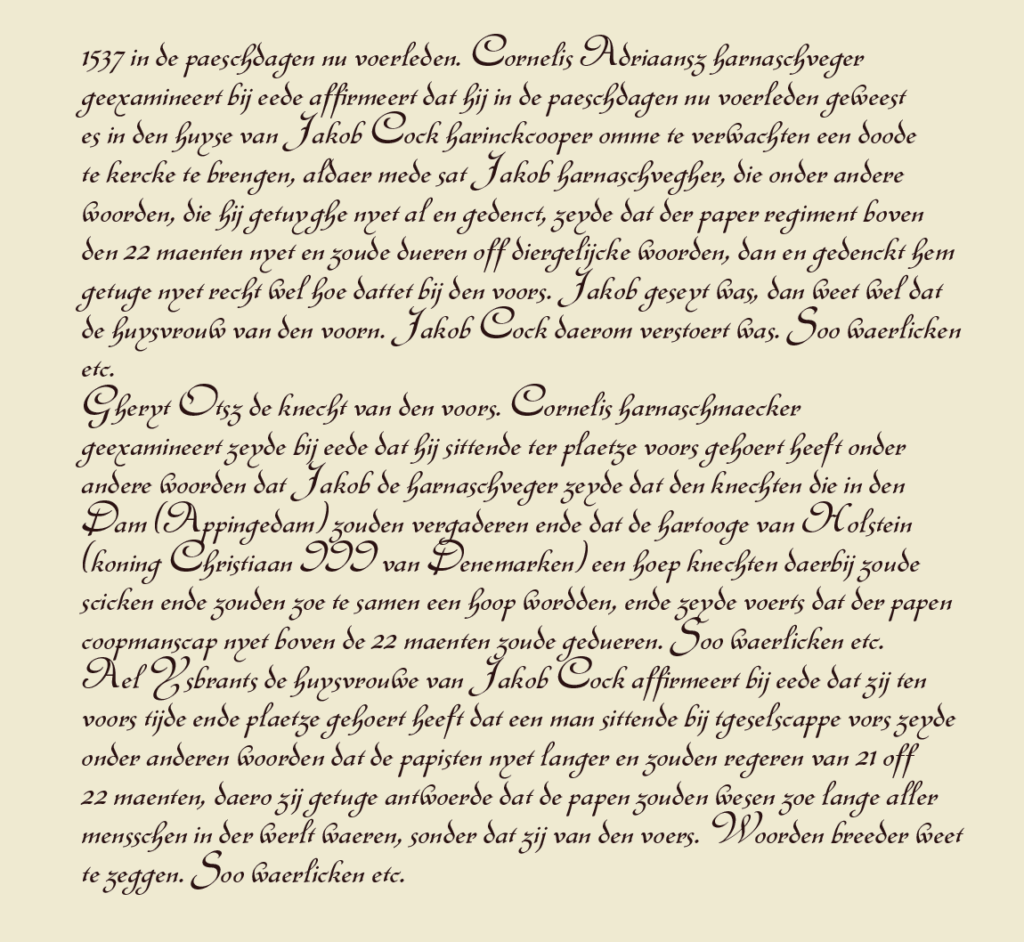
1537, during the recent Easter days – Cornelis Adriaansz., armourer, examined under oath, affirms that during the Easter days just past he was in the house of Jakob Cock, herring merchant, in order to await bringing a dead person to the church. There also sat Jakob the armourer, who, among other words which the witness does not fully recall, said that the papist regime would not last beyond twenty-two months, or words to that effect. The witness does not clearly remember how the aforesaid Jakob expressed it, but does know that the wife of the said Jakob Cock was disturbed by it. So truly, etc.
Gheryt Otsz., servant of the aforesaid Cornelis the armourer, examined, stated under oath that, sitting at the aforesaid place, he heard among other words that Jakob the armourer said that servants would gather in the Dam (Appingedam), and that the Duke of Holstein (King Christian III of Denmark) would send a company of servants there, and that together they would thus become a force; and he further said that the papists’ commerce would not last beyond twenty-two months. So truly, etc.
Ael Ysbrants, wife of Jakob Cock, affirms under oath that at the aforesaid time and place she heard that a man sitting with the aforesaid company said, among other words, that the papists would not continue to rule beyond twenty-one or twenty-two months, to which the witness replied that the papists would last as long as there were people in the world, without being able to say more at length concerning the aforesaid words. So truly, etc.